
▍What It Is
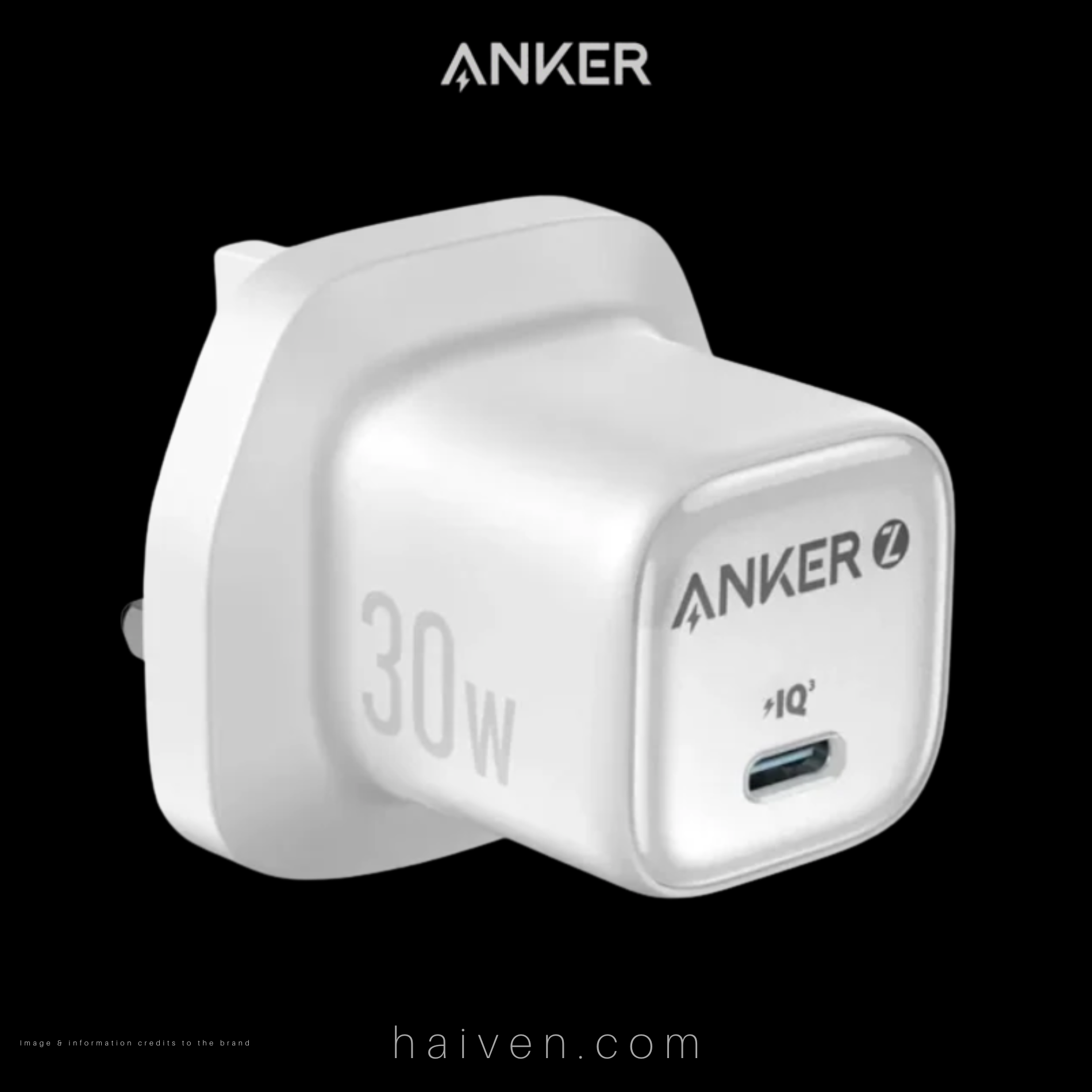
The Anker Zolo Charger 30W, model A2698, is a single-port USB-C wall charger. The version listed on Haiven is the white A2698K21. It is built for the devices most of us carry every day: smartphones, tablets, wireless earbuds, smartwatches and, at a slower pace, lightweight USB-C laptops.
In the box you get the charger and a welcome guide. A USB-C cable is not included, so you will use the cable that came with your phone or another certified USB-C cable.
▍How It Works
The charger uses USB-C Power Delivery 3.0 (PD) and Programmable Power Supply (PPS). When you plug in a device, the charger and the device agree on the voltage and current the device can safely accept. Anker lists five fixed output levels: 5V at 3A (15W), 9V at 3A (27W), 12V at 2.5A (30W), 15V at 2A (30W) and 20V at 1.5A (30W), with a 30W maximum.
PPS lets compatible phones request small step changes in voltage during charging rather than jumping between fixed levels. Many recent Android phones use PPS for their fast-charging modes, while iPhones and iPads use standard USB-C PD.
Inside, Anker uses its GaN II (gallium nitride) design. GaN components switch at higher frequencies than older silicon parts, which allows a smaller transformer and a smaller body. Anker states the A2698 is 25% more compact than its previous models and that its temperature management keeps it 13°C below standard requirements.
The input is rated at 100–240V AC, 50/60Hz, so the charger itself accepts mains power in the UAE and in most countries you might travel to. Depending on the plug type of your unit and your destination, a simple plug adapter may still be needed.
▍Why We Chose It
Most phones sold today charge over USB-C PD, and a well-made 30W charger covers the fast-charging range of many of them. We chose the Zolo 30W because it focuses on that one job: one port, a clear 30W ceiling and support for both PD and PPS, in a body that measures about 3.1 × 3.2 × 3.6 cm according to Anker.
It also pairs sensibly with other electronics we cover. Anker says 30W can take an iPhone 15 to 50% in about 26 minutes. Apple lists 30W as the minimum wattage needed to charge the 13-inch MacBook Air with M5, so the Zolo can top one up overnight or at a desk, although Apple notes that fast charging that laptop needs a 70W or higher USB PD source.
▍What Sets It Apart
Many compact phone chargers are rated at 20W, which is enough for a phone but slow for a tablet. The Zolo 30W reaches 30W at 12V, 15V and 20V, which gives tablets and small laptops more headroom while staying pocket-sized. The combination of PD 3.0 and PPS in one port also means the same charger can serve an iPhone, an iPad and a PPS-based Android phone without switching bricks.
| Specification | Detail |
|---|---|
| Model | Anker Zolo Charger 30W, A2698 (Haiven listing: A2698K21, white) |
| Ports | 1 × USB-C |
| Maximum output | 30W |
| Protocols | USB-C Power Delivery 3.0, PPS |
| Output levels | 5V⎓3A, 9V⎓3A, 12V⎓2.5A, 15V⎓2A, 20V⎓1.5A |
| Input | 100–240V AC, 50/60Hz |
| Technology | GaN II |
| Size (Anker) | About 3.1 × 3.2 × 3.6 cm |
| In the box | Charger and welcome guide (cable not included) |
▍Things to Know Before You Buy
This is a one-device charger. If you want to charge a phone and earbuds at the same time, you will need a multi-port model. It is also not designed to replace the higher-wattage adapter of a larger laptop; it will charge many lightweight USB-C laptops, but more slowly than their own power adapters. Anker's guide notes the charger is meant for IT equipment and indoor use.
▍View It on Haiven
See the Anker Zolo Charger 30W A2698K21 in white on Haiven
▍Why We Recommend It
The Anker Zolo 30W is a sensible everyday charger for anyone in Dubai who wants one small, reliable USB-C brick for a phone, tablet or earbuds. Its 30W ceiling, PD 3.0 and PPS support and compact GaN II build cover most daily charging needs, and its limits are easy to understand: one port, one device, up to 30W.